Sunday, April 14, 2013

Wearing Your Ethics: The Affordability of Fast Fashion

 
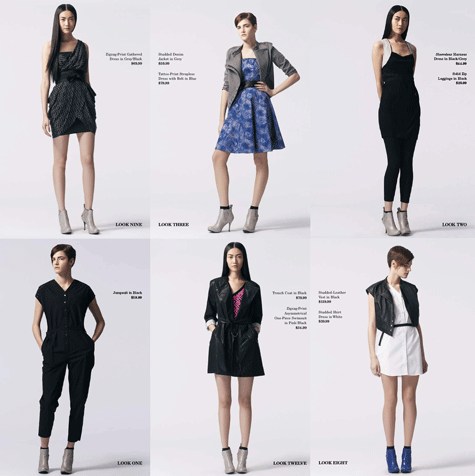
     There are only two basic categories of people who support fast fashion: those who sell it and would like to continue doing so, and those who buy it and would like to continue doing so. There is also a third, silent category of people who aren’t interested in where there clothes come from, and who continue filling their wardrobes in blissful ignorance. Between these three groups, the industry thrives—shoppers and designers alike have praised fast fashion for its resourcefulness and affordability, and even the titans of high fashion are getting involved. Retailers from Topshop to Target have had great success with designer collaborations, selling extremely limited-edition pieces by trendy names like Christopher Kane, Rodarte, and Prabal Gurung at prices as high as they dare. The hype surrounding these designer collections leads to mobs of customers scrambling to get bargains on name-brand clothes, which usually sell out in hours. However, these clothes are of no better quality than any others—all you pay for is the label.

 
     While the intent of bringing designer names to the people is admirable, it is contradictory: the appeal of high-fashion clothing is its luxurious, unattainable nature. People who buy designer clothes do so because they want to know they are paying for the best. This isn’t to say, however, that only the extremely wealthy should be able to own well-made clothes—quality should be the rule, not the exception. It is because of fast fashion that the market is so polluted with throwaway knockoffs. In order to level the playing field between designer clothing and fast fashion, shoppers should stop demanding “more”, and begin asking for “better”.


     Although many may praise fast fashion for its inexpensive prices, it is hypocritical to call it a truly affordable. The fact remains that in order for us to buy twenty dollar jeans and five dollar tee shirts, thousands must live in poverty. People live on pennies a day as a result of sweatshop labor, even if we cannot easily see them or learn their stories. According to Lucy Osborne, “In 2011 a group of workers – 14 Bolivians and one Peruvian – were rescued from an unlicensed factory in Sao Paulo, Brazil, where clothes carrying the Zara label were being produced. The immigrant workers, one of whom was reported to be just 14, were living in dangerous and unhygienic conditions, forced to work 12-hour shifts for between £95 and £176 a month,” (Osborne 13). This quote demonstrates that although cheap fashion may make our daily lives easier, it is at the expense of others. Although fast fashion provides cheap clothes for Americans who need to make ends meet, it is a solution which only creates more problems, and part of an industry which only tries to sweep those problems under the carpet. The popularity of the fair-trade and organic movement reveals that people are willing to spend more to know that they are doing the right thing; it is time we insist that our clothes should be equally ethical.

Work Cited

Osborne, Lucy. "High-Street Fashion Store Zara Accused of Using Slave Labour at Factories in
     Argentina." The Daily Mail 3 Apr. 2013 [U.K.] . Web. 14 Apr. 2013.
     <http://www.dailymail.co.uk/news/article-2303358/High-street-fashion-store-Zara-investigation-
     use-slave-labour-factories-Argentina.html>.

Disagreeing viewpoint, 500 words.

No comments:

Post a Comment