Many people find
it difficult to seriously consider the issue of sweatshop labor because it is too
inconvenient. Unless you want to spring for the hefty “made in America” price
tag, virtually everything available for purchase was probably made in a
sweatshop. It makes no difference if you buy your clothes from a
bargain-basement like Wal-Mart, a trendy teen store, or the outlet of a
high-end brand—the shadow of sweatshop labor engulfs them all.

Take for example a brand like J. Crew. They specialize in cashmere sweaters, fifty dollar tee shirts, and designer collaborations; their website is rife with buzzwords like “quality”, “craftsmanship”, and “hand-applied touches”. Anyone would label them as a luxury brand. However, J. Crew has been accused multiple times of using sweatshops. What is the difference between a two hundred dollar pair of jeans from J. Crew and a forty dollar pair of jeans from American Eagle if they were both manufactured in the same place?
 While shoppers are being misled by
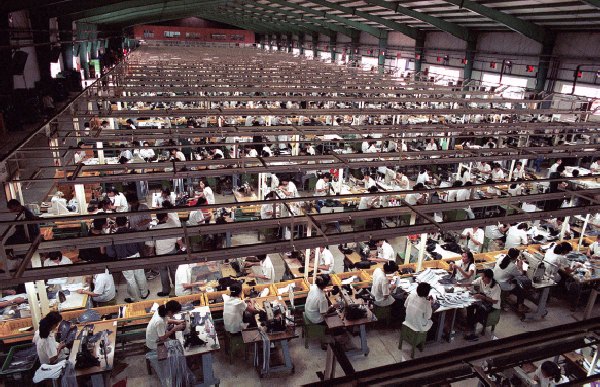
the fashion industry, the true victims of this vicious cycle work in the
factories where these clothes are manufactured. Despite government programs
around the world which seek to regulate and eliminate sweatshops, there is much
that goes unreported. In an industry which thrives off the glorification of
objects, people are the commodities. In a recent article on Cambodian
sweatshops Heather Stilwell says, “At $61 per month, the real minimum wage of
workers has actually declined about 14 per cent since 2000 once inflation is
taken into account and manual labour is hard going when you can barely afford
to eat,” (Stilwell 3). In other words, wages are decreasing even as demand is
increasing. And attempts by workers to speak out for their rights have been met
with violent suppression. Stilwell explains, “In February 2012, more than 1,000
workers protested for better wages outside Kaoway Sports factory, which
supplies footwear to the German Puma brand. The town governor shut down the
demonstration by opening fire on the crowd, shooting and injuring three women,
the youngest of whom was 18 years old. The governor walked free, and business
continued as usual.” (Stilwell 5). This means that workers are forced to choose
between their freedom, their jobs, and in extreme cases, their lives. Because
they so often must keep silent, Americans are not always aware of horrors of
sweatshop labor. It is not easy to imagine starvation and abject poverty while
shopping in a trendy department store and many would rather choose not to. Knowingly
or not, we support the exploitation of thousands with every purchase we make.
Conditions for workers will only improve when shoppers start demanding
transparency and integrity in the fashion industry.
While shoppers are being misled by
the fashion industry, the true victims of this vicious cycle work in the
factories where these clothes are manufactured. Despite government programs
around the world which seek to regulate and eliminate sweatshops, there is much
that goes unreported. In an industry which thrives off the glorification of
objects, people are the commodities. In a recent article on Cambodian
sweatshops Heather Stilwell says, “At $61 per month, the real minimum wage of
workers has actually declined about 14 per cent since 2000 once inflation is
taken into account and manual labour is hard going when you can barely afford
to eat,” (Stilwell 3). In other words, wages are decreasing even as demand is
increasing. And attempts by workers to speak out for their rights have been met
with violent suppression. Stilwell explains, “In February 2012, more than 1,000
workers protested for better wages outside Kaoway Sports factory, which
supplies footwear to the German Puma brand. The town governor shut down the
demonstration by opening fire on the crowd, shooting and injuring three women,
the youngest of whom was 18 years old. The governor walked free, and business
continued as usual.” (Stilwell 5). This means that workers are forced to choose
between their freedom, their jobs, and in extreme cases, their lives. Because
they so often must keep silent, Americans are not always aware of horrors of
sweatshop labor. It is not easy to imagine starvation and abject poverty while
shopping in a trendy department store and many would rather choose not to. Knowingly
or not, we support the exploitation of thousands with every purchase we make.
Conditions for workers will only improve when shoppers start demanding
transparency and integrity in the fashion industry.

Take for example a brand like J. Crew. They specialize in cashmere sweaters, fifty dollar tee shirts, and designer collaborations; their website is rife with buzzwords like “quality”, “craftsmanship”, and “hand-applied touches”. Anyone would label them as a luxury brand. However, J. Crew has been accused multiple times of using sweatshops. What is the difference between a two hundred dollar pair of jeans from J. Crew and a forty dollar pair of jeans from American Eagle if they were both manufactured in the same place?
Work Cited
Stilwell, Heather. "Stitched up: garment workers in
Cambodia are supposedly protected by
an independent factory-monitoring programme. But the country does not live up to
its 'sweatshop-free' reputation." New Internationalist Jan. 2013: 38+. Global Issues In Context.
Web. 2 Apr. 2013.
an independent factory-monitoring programme. But the country does not live up to
its 'sweatshop-free' reputation." New Internationalist Jan. 2013: 38+. Global Issues In Context.
Web. 2 Apr. 2013.
Blog post three, 448 words.

No comments:
Post a Comment