Sunday, April 14, 2013

Wearing Your Ethics: The Affordability of Fast Fashion

 
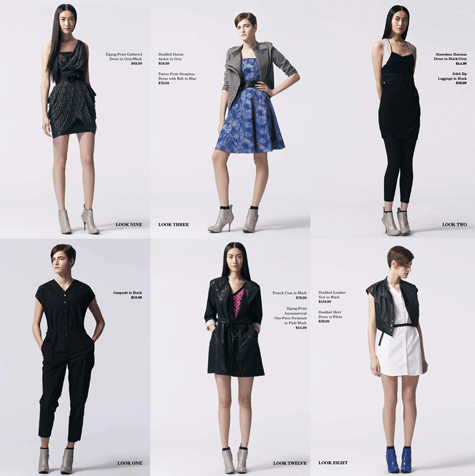
     There are only two basic categories of people who support fast fashion: those who sell it and would like to continue doing so, and those who buy it and would like to continue doing so. There is also a third, silent category of people who aren’t interested in where there clothes come from, and who continue filling their wardrobes in blissful ignorance. Between these three groups, the industry thrives—shoppers and designers alike have praised fast fashion for its resourcefulness and affordability, and even the titans of high fashion are getting involved. Retailers from Topshop to Target have had great success with designer collaborations, selling extremely limited-edition pieces by trendy names like Christopher Kane, Rodarte, and Prabal Gurung at prices as high as they dare. The hype surrounding these designer collections leads to mobs of customers scrambling to get bargains on name-brand clothes, which usually sell out in hours. However, these clothes are of no better quality than any others—all you pay for is the label.

 
     While the intent of bringing designer names to the people is admirable, it is contradictory: the appeal of high-fashion clothing is its luxurious, unattainable nature. People who buy designer clothes do so because they want to know they are paying for the best. This isn’t to say, however, that only the extremely wealthy should be able to own well-made clothes—quality should be the rule, not the exception. It is because of fast fashion that the market is so polluted with throwaway knockoffs. In order to level the playing field between designer clothing and fast fashion, shoppers should stop demanding “more”, and begin asking for “better”.


     Although many may praise fast fashion for its inexpensive prices, it is hypocritical to call it a truly affordable. The fact remains that in order for us to buy twenty dollar jeans and five dollar tee shirts, thousands must live in poverty. People live on pennies a day as a result of sweatshop labor, even if we cannot easily see them or learn their stories. According to Lucy Osborne, “In 2011 a group of workers – 14 Bolivians and one Peruvian – were rescued from an unlicensed factory in Sao Paulo, Brazil, where clothes carrying the Zara label were being produced. The immigrant workers, one of whom was reported to be just 14, were living in dangerous and unhygienic conditions, forced to work 12-hour shifts for between £95 and £176 a month,” (Osborne 13). This quote demonstrates that although cheap fashion may make our daily lives easier, it is at the expense of others. Although fast fashion provides cheap clothes for Americans who need to make ends meet, it is a solution which only creates more problems, and part of an industry which only tries to sweep those problems under the carpet. The popularity of the fair-trade and organic movement reveals that people are willing to spend more to know that they are doing the right thing; it is time we insist that our clothes should be equally ethical.

Work Cited

Osborne, Lucy. "High-Street Fashion Store Zara Accused of Using Slave Labour at Factories in
     Argentina." The Daily Mail 3 Apr. 2013 [U.K.] . Web. 14 Apr. 2013.
     <http://www.dailymail.co.uk/news/article-2303358/High-street-fashion-store-Zara-investigation-
     use-slave-labour-factories-Argentina.html>.

Disagreeing viewpoint, 500 words.

Tuesday, April 9, 2013

Wearing Your Ethics: Finding Alternatives


     Although fast fashion pervades mainstream retail, alternatives do exist. For instance, shoppers looking for something unique can support small businesses through websites like Etsy.com, an online marketplace which allows artisans to sell their products easily and reliably. The click of a button allows you to find diverse, beautiful pieces which could never be found on the racks of a department store, and with a bonus of knowing exactly where your money is going: to support talented individuals and provide them with the means to continue with their craft.


     Those looking for a lower price point often turn to vintage or secondhand stores, where hidden treasures abound—all it takes is a good eye for quality and a little time to search the racks. With luck you can leave with a shopping cart full of clothes at prices cheaper than the deepest recesses of a Wal-Mart clearance bin, and at thrift stores such as Goodwill or the Salvation Army the proceeds go to charity. If the idea of digging through piles of unwanted clothes is not appealing, there are many “boutique” style second-hand stores which use lavish décor, fashion-forward staff, and brand-name clothes to alleviate the “bargain basement” stereotype. Buying used clothes does not only provide the opportunity to experiment with different looks and creative styling, but also it is better for the environment. When you buy from thrift stores, you save beautiful, well-made clothes from the landfill—it is hard to find a better excuse for impulse shopping.
 
     While the eco-conscious mantra of “reduce, reuse, recycle” finds its application in second-hand shopping, the options do not end there. The popular store American Apparel, founded by Don Charney, manages to sell a stylish range of clothing at prices comparable to fast fashion retailers while still maintaining the label of “sweatshop free”. The business model is surprisingly transparent—refreshing in an industry rife with shadowy dealings, outsourcing, and obscurity. According to an NPR article by Amy Walters, “From his top-floor office, Charney and his staff figure out what's selling well and quickly, then fill in the sewing managers one floor below. The quick process means the company's supply has a much better chance of matching demand. The American Apparel factory is so nimble, it can get 1,000 T-shirts out the door in a single day,” (Walters 12). This demonstrates that alternatives to fast fashion do not need to be very slow at all. Although at times it may be impossible to abstain from the sugary-sweet gratification of fast fashion, there are many available options which make ethical shopping not only easy but delightful.


Work Cited
Walters, Amy. "Fast Fashion's Challenge: Making Money With 'Made In The USA'." NPR.org 13

     Mar. 2013. Web. 9 Apr. 2013. <http://www.npr.org/2013/03/13/174199449/fast-fashions-

     challenge-making-money-with-made-in-the-usa>.

Miscellaneous post,  431 words.

Sunday, April 7, 2013

Wearing Your Ethics: Sweatshop Labor


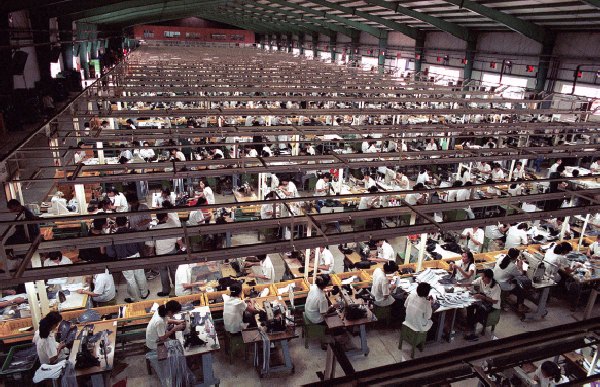
     Many people find it difficult to seriously consider the issue of sweatshop labor because it is too inconvenient. Unless you want to spring for the hefty “made in America” price tag, virtually everything available for purchase was probably made in a sweatshop. It makes no difference if you buy your clothes from a bargain-basement like Wal-Mart, a trendy teen store, or the outlet of a high-end brand—the shadow of sweatshop labor engulfs them all.


     Take for example a brand like J. Crew. They specialize in cashmere sweaters, fifty dollar tee shirts, and designer collaborations; their website is rife with buzzwords like “quality”, “craftsmanship”, and “hand-applied touches”. Anyone would label them as a luxury brand. However, J. Crew has been accused multiple times of using sweatshops. What is the difference between a two hundred dollar pair of jeans from J. Crew and a forty dollar pair of jeans from American Eagle if they were both manufactured in the same place?
 
 
     While shoppers are being misled by the fashion industry, the true victims of this vicious cycle work in the factories where these clothes are manufactured. Despite government programs around the world which seek to regulate and eliminate sweatshops, there is much that goes unreported. In an industry which thrives off the glorification of objects, people are the commodities. In a recent article on Cambodian sweatshops Heather Stilwell says, “At $61 per month, the real minimum wage of workers has actually declined about 14 per cent since 2000 once inflation is taken into account and manual labour is hard going when you can barely afford to eat,” (Stilwell 3). In other words, wages are decreasing even as demand is increasing. And attempts by workers to speak out for their rights have been met with violent suppression. Stilwell explains, “In February 2012, more than 1,000 workers protested for better wages outside Kaoway Sports factory, which supplies footwear to the German Puma brand. The town governor shut down the demonstration by opening fire on the crowd, shooting and injuring three women, the youngest of whom was 18 years old. The governor walked free, and business continued as usual.” (Stilwell 5). This means that workers are forced to choose between their freedom, their jobs, and in extreme cases, their lives. Because they so often must keep silent, Americans are not always aware of horrors of sweatshop labor. It is not easy to imagine starvation and abject poverty while shopping in a trendy department store and many would rather choose not to. Knowingly or not, we support the exploitation of thousands with every purchase we make. Conditions for workers will only improve when shoppers start demanding transparency and integrity in the fashion industry.

Work Cited

Stilwell, Heather. "Stitched up: garment workers in Cambodia are supposedly protected by

     an independent factory-monitoring programme. But the country does not live up to

     its 'sweatshop-free' reputation." New Internationalist Jan. 2013: 38+. Global Issues In Context.

     Web. 2 Apr. 2013.

Blog post three, 448 words.